

 Back
Back

30.06.2026 | Story
Sealing requirements along the H2 value chain?
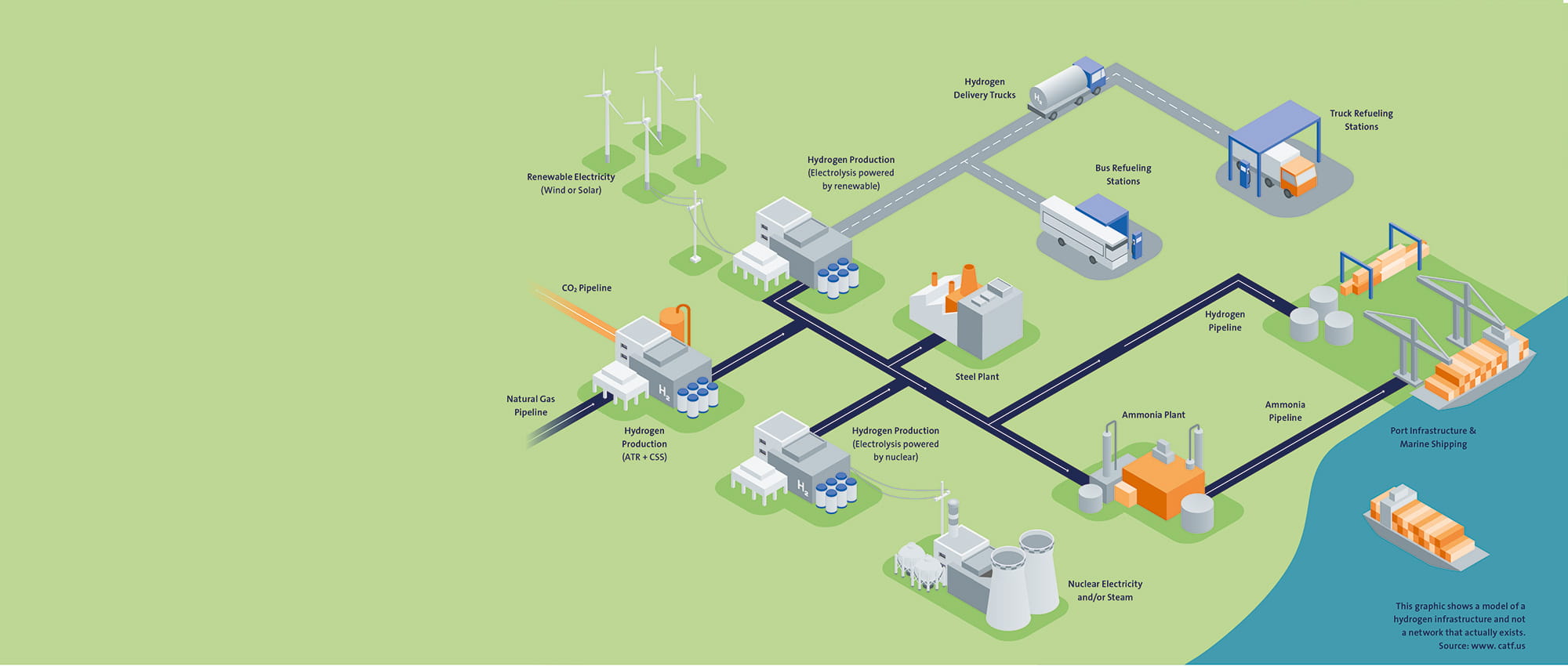
The requirements for sealing solutions are defined by the media and temperatures involved in hydrogen production and processing, transport, storage, and use. This spectrum covers a broad range: from different electrolysis processes, compression, purification, transport and storage in gaseous, liquid form (cryogenic) or derivatives such as methanol or ammonia, all the way to the end use in fuel cell systems (FC - fuel cell) or hydrogen internal combustion engines (HICE).





What are the sealing requirements along the H2 value chain?
Production: PEM, AEM, AEL, and SOEC electrolyzers
Operating parameters and risks
Permeation
H2 permeation causes hydrogen losses and creates a safety risk. Low-permeability material formulations are effective in preventing this. They include CIIR (chlorobutyl rubber), HNBR (hydrogenated nitrile butadiene rubber), EPDM (ethylene propylene diene rubber), and FKM (fluoroelastomer). In this context, it is important to simulate and validate the materialspecific permeation coefficients of the seals for each application.
Explosive decompression (RGD)
RGD-resistant materials are required wherever rapid pressure changes occur, for example in tank or compressor environments. These include EPDM, FVMQ (fluorosilicone rubber), and PVMQ (phenyl methyl silicone), among others. The materials used here must have a proven RGD resistance up to ≥ 700 bar.
Media resistance
PEM electrolysis requires seals to withstand dilute sulfuric acid and continuous exposure to O2. In addition, highly pure materials must be used to ensure that no metal ions leach out and cause ionic contamination.
AEL electrolysis requires seals to withstand a 20-40 percent potassium hydroxide solution. The conventional temperature range (standard AEL) involves operating temperatures of 60–80 °C, an elevated temperature range (modern/optimized AEL) involves operations at 80–90 °C, and high-temperature alkaline electrolysis (advanced AEL) reaches operating temperatures of 100–120 °C. In research and development projects, the operating temperatures can even reach 150 °C. In addition, the oxygen pressure in this application is 35–40 bar. This means that the sealing materials are exposed to strong oxidation with the resulting accelerated material aging. EPDM has proven to be reliable in this area.
Thermal resistance
The sealing materials must also meet the strictest requirements in terms of temperature resistance. Environmental conditions range from <20 to 80 °C during the cold start of a PEM electrolyzer to >800 °C in SOEC applications. Furthermore, tempering processes must be optimized to prevent what is known as fuel cell poisoning. Seal geometry is another fundamental factor in ensuring perfect performance. The seals must pass compression set tests that take all load cases into account, including thermal cycles.
Material and design recommendations
PEM-Stacks
- FKM is ideal for O2 pressure resistance.
- EPDM/FKM compounds are used in overmolded frames (bonded systems) for reliable assembly and sealing.
- Good to know: There are integrated stack frame seals with an L/C cross section that improve barrier performance under operating pressure. During assembly, the cross section has an innovative L-shape. When the electrolyzer starts operating, its internal pressure rises and activates the seal, which then takes on a C-shape. The increases the seal’s contact pressure and turns it into a reliable barrier for gases and liquids.
AEM-Stacks
- Material purity and membrane compatibility are the priorities here.
- EPDM has proven effective in the alkaline environment of AEM stacks.
AEL-Stacks
- PTFE (polytetrafluoroethylene) and ePTFE seals (expanded PTFE) are resistant to the challenging continuous contact with oxygen and potassium hydroxide.
- Under suitable framework conditions, EPDM is a sustainable alternative.
Processing: Compression, purification, and conditioning
Components and parameter spaces
Reciprocating compressors (H2)
Reciprocating compressors operate in pressure ranges of 50–500 bar and 350–1000 bar. Small units are designed for a service life of more than 1,000 hours, whereas large units are expected to provide full performance for a period between 8,000 and 24,000 hours. The sealing systems used here (piston rings, rod seals, packings) must be low-wear and absolutely leak-tight and can already function without using PFAS.
Scroll compressors (compressors and vacuum pumps)
Scroll compressors and scroll vacuum pumps operate in pressure ranges of 1–2 bar and a temperature range of -35 to 110 °C. These traditionally use scroll seals (tip seals) made of special PFTE. However, there is a trend towards finding alternative PFAS-free materials.
Tribology and wear
Comprehensive test methods are required to minimize friction-driven interactions between surfaces in compressors, purification systems, and H2 conditioning processes. These methods are used to test
and optimize coefficients of friction and linear wear under realistic conditions. In these applications, fiberreinforced thermoplastics such as PEEK (polyether ether ketone) and PPS compounds (high-performance thermoplastics) offer low friction and therefore low wear.
Transport and storage: Gas, LH2, and refueling stations
Components and parameter spaces
Gas and high-pressure storage
These elements of the H2 value chain are subject to the requirements in UN Regulation R134 with regard to the safety-related properties of hydrogen- and fuel-cell-powered vehicles (HFCVs) and their components. The applications involve O-rings, back-up rings, and valve tappets made of EPDM, FKM, and NBR (acrylonitrile butadiene rubber) that have proven resistance to RGD (rapid gas decompression).
H2 liquid gas transport at -253 °C (cryogenic)
It is crucial for the materials and coating systems used here to remain ductile even at very low temperatures. For this reason, magnet systems and couplings require hydrogen-compatible surfaces that resist embrittlement as effectively as possible.
Refueling stations and refueling
Hydrogen refueling stations and refueling operations involve rapidly changing pressure profiles. RGD-safe elastomers that provide low permeation are used here as well. Regular maintenance intervals should be specified to ensure smooth system operation.
Utilization: fuel cells and hydrogen internal combustion engines (H2 ICE)
Components and parameter spaces
Fuel cells – AFC, PEMFC, PAFC, DMFC, MCFC, SOFC
The six types of hydrogen fuel cells listed above are currently used worldwide. Their differences lie in the gases used, the types of electrolytes, the operating temperature, and their performance capacities. They can be adapted to different requirements. The operating temperatures for LT-PEMFC are 60–80 °C and for HT-PEMFC they are 120–180 °C. PAFC operates at 160–220 °C, MCFC at 620–650 °C, and SOFC at 800–1000 °C. Stack seals made of EPDM, FCPO, FKM, and LSR are used in these applications. It is important to select the materials according to the following properties: their compression set, permeation, and media resistance.
Good to know: For optimum service life and performance of the fuel cells, integrated seals at the interface between the bipolar plate and the gas diffusion layer improve the removal of liquid water from the reaction zones.
Hydrogen internal combustion engine (H2-ICE)
The key advantages of manufacturing H2 internal combustion engines are the robustness of the technology and the rapid market introduction. All the same, the following challenges must be resolved to ensure that these drive system operate safely: NH3 outgassing, the use of lubrication systems, and abnormal combustion. It is crucial to consider the prevailing temperature range and interaction of all the above-mentioned media when selecting the appropriate sealing systems.
Which seals are required and where?
Is there a summary table for applications and typical use cases along with suitable material classes and seal designs?
There is now – and it addresses the question of which seal designs optimize the safety, durability, and efficiency across the entire hydrogen process chain.
The dynamic evolution of technologies for hydrogen generation has been accom panied by a sharply rising learning curve for materials and seal designs. Due to outstanding achievements in materials research and specialized H2 seal designs, many established materials have evolved into highly safe precision sealing solu tions. Advances in production and testing methods are making them increasingly sustainable, durable, and powerful. Which combinations are especially recom mended?
| Application | Typical operating conditions | Material class and sealing solution |
|---|---|---|
| PEM electrolyzer – stack (O₂ side) |
pH 4–6 (pure water, possibly slightly acidic), T < 60–150 °C, p up to ~35 bar high oxidation and cleanliness requirements |
FKM as a stack seal (O₂ resistance, low H₂ permeation) Seal on plastic or metal frame/plate Seal on bipolar plate (overmolding) |
| PEM electrolyzer – high-pressure seal |
high internal pressures, secure groove position, activation under load |
Innovative seal profiles (L-shape) with retention features (press-in-place – PIP) or overmolded onto a carrier |
| AEL and AEM electrolyzer – stack (KOH environment) |
3–30 wt.% KOH T < 60–150 °C p up to ~35 bar electrical insulation depending on system design |
EPDM seals with retention features (PIP) or overmolded onto a carrier produced by injection molding or extrusion PTFE flat seals or films with low creep tendency seal on plastic or metal frame (depending on automation) |
| Electrolyzer – peripheral and flange connections |
low bolt load, purity, electrical insulation, variable T/P |
EPDM and FKM O-rings PTFE flange seals |
| CGH₂ storage and transport (tanks and pipelines) |
T ≈ -50…+85 °C p up to ~105 MPa permeation to be minimized |
O-rings (EPDM/FKM/HNBR depending on medium and temperature) depending on application, with plastic back-up rings (PEEK, etc.) |
| Ultra-high-purity and high-pressure connections |
UHP requirements (clean, low diffusion) vacuum (pressure, very low leakage) |
VCR® metal face seal (stainless steel/nickel alloys) metal-to-metal sealing for UHP lines and components |
| H₂ compressors – reciprocating and diaphragm |
high pressure, dynamic movement, wear, leakage minimization |
packing seals (PTFE-filled, graphite) labyrinth seals, PEEK back-ups for extrusion protection |
| H₂ compressors – centrifugal |
continuous rotation, high speed, low-energy sealing |
dry gas seals (non-contact, thin gas film) very low leakage, low wear |
| Pumps and valves in PtX processes |
corrosive media, high T/P, changing loads |
mechanical seals, graphite packings, static spiral-wound seals/camprofile serrated gaskets, PTFE depending on medium/T |
| PtX syntheses (NH₃, methanol, e‑fuels) |
aggressive chemicals thermal cycles, high pressures |
graphite laminates/spiral-wound/camprofile serrated gaskets modified PTFE (chemical resistance, set behavior) |
| Threads and screwed connections (peripherals) |
Up to 100 % H₂ reliable leakage protection at pipe threads |
hydrogen-ready thread sealants (e.g. LOCTITE 55/567/577) |
| Material behavior – selection guidance |
Permeation (H₂ diffuses strongly) RGD for rapid pressure changes |
FKM tends to have lower H₂ permeation than EPDM/NBR HNBR/FKM/FFKM compounds show RGD resistance profile cross sections/sealing grooves reduce assembly force and extrusion |
The Hydrogen Rainbow
All hydrogen is not the same. Although it is colorless in its natural form, we differentiate it into seperate color classes based on its mode of production. Whether it is green, yellow or gray, we explain what it stands for.

White
This is the natural hydrogen that exists in the environment. It is mostly found in layers of rock deep in the earth. It can be extracted with hydraulic fracturing or thermal fracking.
CO2-neutral: NO
Thermal fracking is only CO2-neutral if renewable energy is exclusively used in the process.

Yellow
Here the electric current for the electrolysis comes from the mix of power sources available today.
CO2-neutral: NO
Since the global electric power mix was only about 30% renewable in 2023, it is not (yet) carbon-neutral.

Orange
Biomass is used for the production of this type of hydrogen. The process can take place in two ways. Either by heating the biomass and then filtering the hydrogen out of the resulting gases. Or with electrolysis, with the electricity coming solely from waste incineration facilities.
CO2-neutral: NO
CO2 is one of the gases released as biomass is incinerated.

Purple
The hydrogen is extracted with electrolysis. Electricity from nuclear power is exclusively used in this case.
CO2-neutral: NO
While the production with nuclear power is CO2-neutral, carbon dioxide is emitted over the lifecycle of nuclear electric power, in the mining of uranium or the processing of nuclear fuel, for example.

Green
The electricity for the electrolysis comes exclusively from renewable energy sources such as photovoltaics and wind energy.
CO2-neutral: YES
The hydrogen is only produced using a CO2-neutral and environmentally friendly process.
Turquoise
Methane is used instead of water in the production of this type of hydrogen. Methane is broken down into solid carbon and hydrogen with methane pyrolysis.
CO-neutral: YES
Solid carbon is produced instead of CO2. The material can then be reused.

Blue
This hydrogen is produced with the steam reformaten of natural gas. The methane reacts with water vapor.
CO2-neutral: NO
The resulting CO2 is not released into the atmosphere but rather compressed underground.

Brown
To produce this kind of hydrogen, brown coal is transformed into a synthetic gas under high temperatures and controlled oxygen input.
CO2-neutral: NO
The synthetic gas mainly consists of H2 and CO2.

Gray
This type of hydrogen is extracted from natural gas. Using steam reformation, methane is transformed into hydrogen and carbon dioxide. This is how most hydrogen is produced worldwide.
CO2-neutral: NO
The ratio of hydrogen to carbon dioxide is 1:10 in natural gas, mirroring the proportion of the hydrogen that is generated and the CO2 that is released.

Black
Much like brown hydrogen, coal is the base material for the production of hydrogen. Instead of brown coal, hard coal is used here. The coal is gasified and broken down into hydrogen and carbon monoxide.
CO2-neutral: NO
As is the case with brown hydrogen, this process releases substantial quantities of CO2.
Which materials are suitable for each type of seal?
The material selection always follows the medium–temperature–pressure cycle and takes the service life and purity into account. The following rule-based guidance does not claim to be exhaustive.
Elastomers for O-rings, frame seals, molded seals, and profilese
EPDM: resistant to KOH and water, good low-temperature flexibility; suitable for AEL/AEM and for peripherals in the electrolysis environment; has higher H2 permeation than FKM. Caution is required in direct contact with oxygen.
FKM: withstands O2 oxidation and high temperatures; resistant to deionized water (DI water) and acidic environments; suitable for PEM stacks and peripheral valves and seats; low H2 permeation. RGD-resistant materials are available for applications with pressure fluctuations.
HNBR/NBR: good mechanical strength; widely used for gases; oil-resistant. RGD-resistant materials are available for applications with pressure fluctuations.
FFKM: maximum chemical resistance; suitable for critical PtX process steps and for high temperatures.
Fluoropolymers and thermoplastics for flat seals, sealing lips, and back-ups
PTFE, ePTFE, and modified PTFE: nearly universal chemical resistance; prone to creep, should be placed in main load area; low permeation. This makes them ideal for KOH, CO2, and flange seals in stacks and fittings.
PEEK: ideally suited for back-up rings and spring energizers. These thermoplastics offer high rigidity and temperature resistance. At the same time, they provide good extrusion protection in high-pressure applications.
Other Topics

First Hand News
Best of all, keep up with the latest developments
with the Freudenberg Sealing Technologies newsletter.

 Back to Top