

 Back
Back

Obtain news and background information about sealing technology, get in touch with innovative products – subscribe to the free e-mail newsletter.

Ready For The Future
Sustainability at Freudenberg Sealing Technologies
We recognize the many facets of sustainability …
… and turn them a little more to our advantage every day.
Long-term thinking and values-based action have been part of Freudenberg’s DNA for more than 175 years. At Freudenberg Sealing Technologies, we see these as a responsibility toward our employees, our customers, society and the environment.
With our judicious and forward-looking approach, we are laying the foundation for our company’s success. This enables us to identify numerous opportunities: opportunities to unlock the potential within our workforce. Opportunities to produce with more cost awareness and less waste. Opportunities to identify measures that help us to reduce our environmental impact going forward.
Every one of us plays a part in this effort. That is why we have established programs and competitions over the years that encourage people to identify opportunities for improvement every day.
By offering the “We all take care!” award every year, Freudenberg invites its sites and employees around the world to nominate projects. Projects that help advance occupational safety, enhance employee health and improve the responsible use of resources. This is how we make our efforts visible and motivate others to follow their example. Examples can be found further down on this page.
The e₂ program, by contrast, is a Freudenberg initiative through which we promote education and environmental protection. It aims to inspire employees to get involved locally in nonprofit projects related to education and environmental protection.
We document all our actions in a sustainability report, in which we present our progress transparently for anyone who is interested.
Our sustainability strategy – backed by numbers
Our sustainability strategy encompasses all three ESG dimensions: Environmental, Social and Governance. We align our environmental targets with the Freudenberg Group’s sustainability strategy while setting additional priorities of our own in the areas of Social and Governance. A key guiding principle is the interplay between footprint and handprint: By striving to reduce the environmental impact of our own processes, we also develop products and solutions that can assist our customers in reducing their emissions.
The following section show what this means in concrete terms – with measurable results.
Keeping a rigorous focus on CO₂ emissions – and continuing our reductions
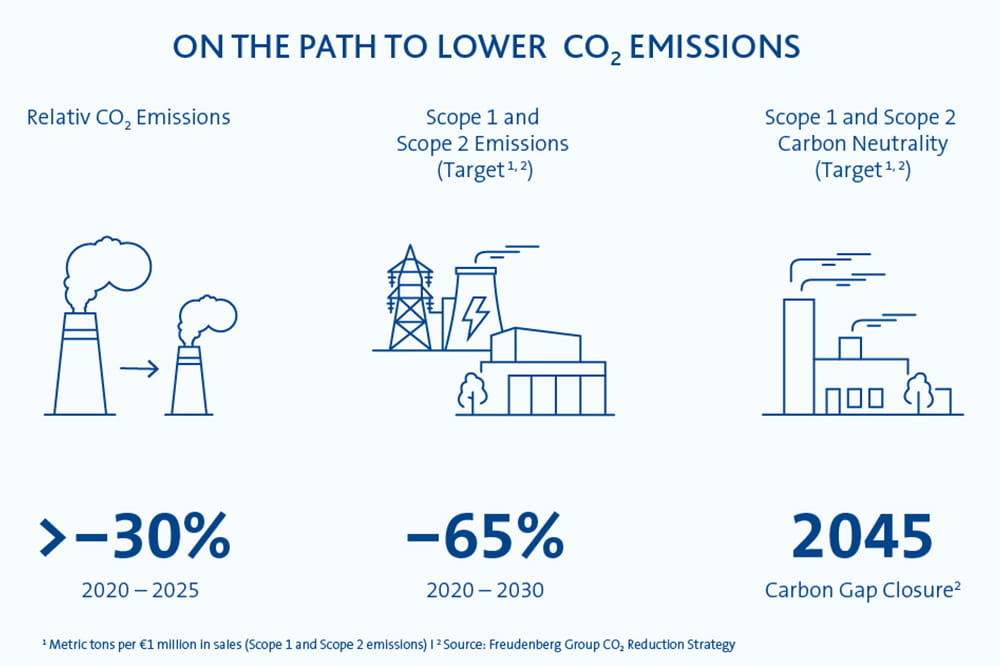
Between 2020 and 2025, we lowered our relative CO₂ emissions – measured in tons per €1 million in sales – by more than 30%. This means that we not only achieved but even surpassed the interim target of 25% set out in our sustainability strategy. Our next goals are clearly defined: By 2030, we aim to reduce our Scope 1 and Scope 2 emissions by 65% compared with 2020 and, by 2045, we plan to reduce our remaining Scope 1 and Scope 2 emissions as much as possible in order to achieve net zero.
We base this on a multi-stage strategy that comprises emissions avoidance, electrification and the expansion of renewable energy. Any residual emissions that are not technically preventable are considered separately and not equated with active reduction measures. This transformation is kicked off by initiatives that are already underway, including the Fossil Fuel Transition Program and the expansion of photovoltaic systems at FST sites.
More information on how the Freudenberg Group as a whole intends to implement CO₂ reduction measures in order to achieve its targets of CO₂ reduction and carbon neutrality can be found in the corresponding Strategic Roadmap.
Success is often already evident on a small scale. One example: At Freudenberg Sealing Technologies, a joint project with our sister company SurTec in Simmerring® production at the Weinheim site delivers measurable benefits by using a special cleaning agent to degrease the metal parts of our Simmerrings®. Lowering the process temperature by 20 degrees Celsius means that we require 50% less energy and reduce CO₂ emissions by the same amount. At the same time, we need fewer chemicals and can use the same alkalies for longer.
Decreasing energy consumption – and steadily increasing the share of renewable energy
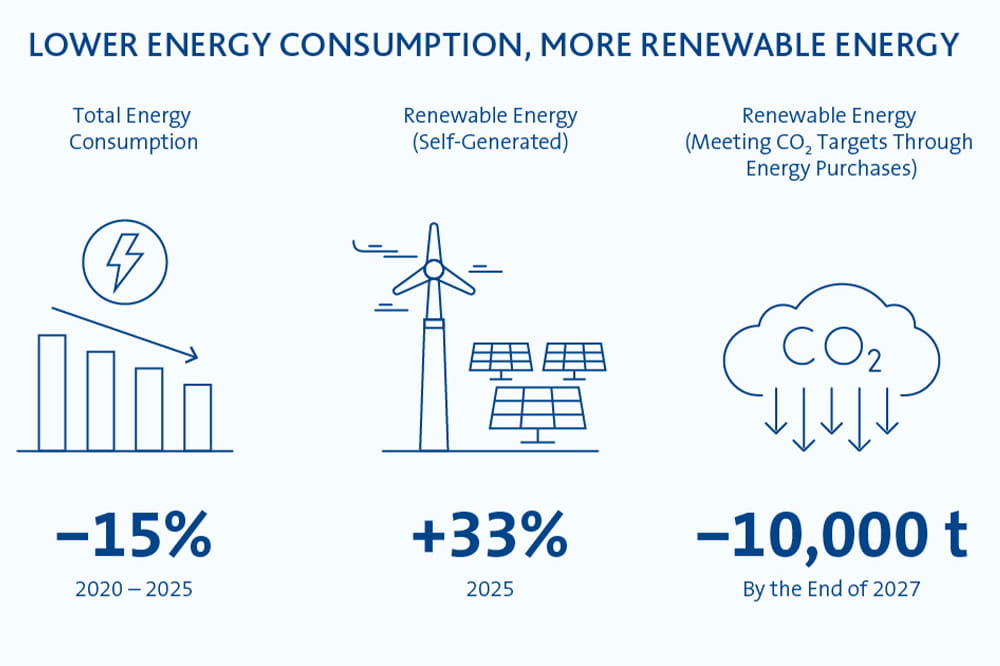
Thanks to electrification and continuous process optimization, we reduced our total energy consumption by 15% between 2020 and 2025. At the same time, we are consistently increasing the share of renewable energy: In 2025, 47.5% of our electricity consumption came from renewable sources. The amount of renewable energy we generated in-house rose from 0.96 GWh to 1.28 GWh – an increase of around one-third within a year. This progress is the result of targeted investments in photovoltaic systems at our sites worldwide, supplemented by measures such as heat recovery and digital energy monitoring. The next step is already underway: By further expanding our renewable energy purchasing agreements, we aim to conserve around 10,000 tons of CO₂ by the end of 2027. Additional sites are gradually being converted entirely to renewable energy sources.
When building new plants, such as that in Morinda, India, the goal of conserving energy is incorporated into our planning from the very start. This includes building architecture designed for low energy consumption (for example through insulation) as well as the use of photovoltaic systems and full energy monitoring. In Necedah, Wisconsin, our site uses geothermal cooling for its equipment and processes, while our plant in Manchester, New Hampshire, has achieved rapid successes by systematically evaluating operating data. This allowed us to avoid purchasing new post-curing ovens for our seals in Manchester. Instead, we organized the post-curing process more efficiently and were even able to shut down some of the ovens without replacing them.
Diversity & leadership – diversity as a value to live by
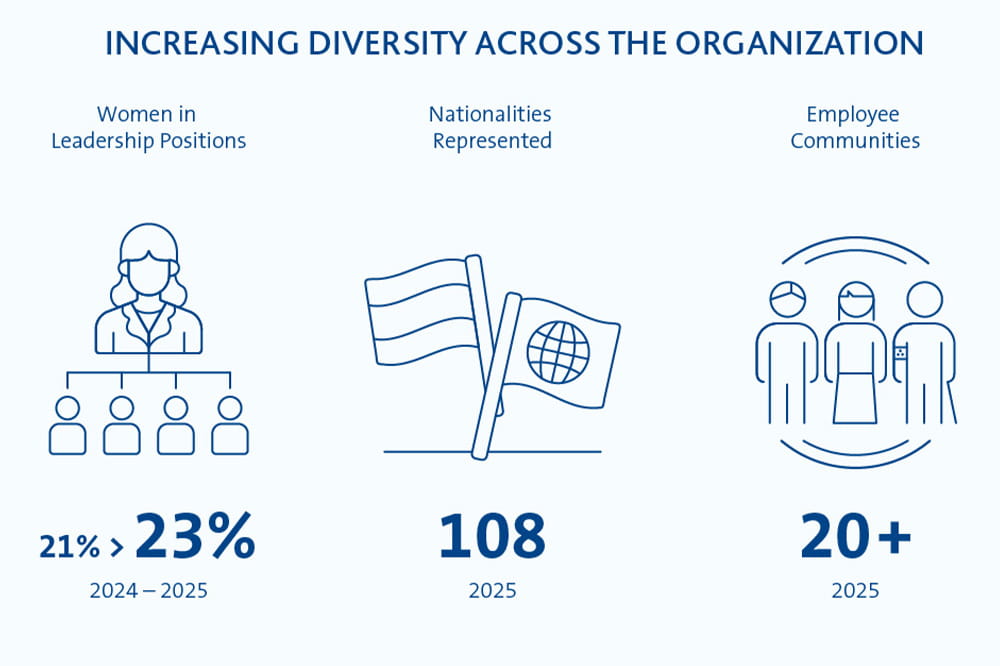
While women currently make up around 35% of our workforce, their share of leadership positions is continuously increasing. Most recently, it rose from 21% in 2024 to 23% in 2025. Employees from 108 nations work for us around the world, underscoring the cultural diversity of our company. Our goal for the future is to continue improving the regional and gender balance and to systematically create more opportunities outside Europe.
Various communities in our company offer opportunities for specific social groups – such as young or female employees – to meet and talk, while also welcoming the entire workforce. Workstreams within these global networks revolve around topics such as communication, professional development and people leadership. Alongside workshops and presentations, we have also created a platform for discussing and reflecting on relevant topics with like-minded colleagues.
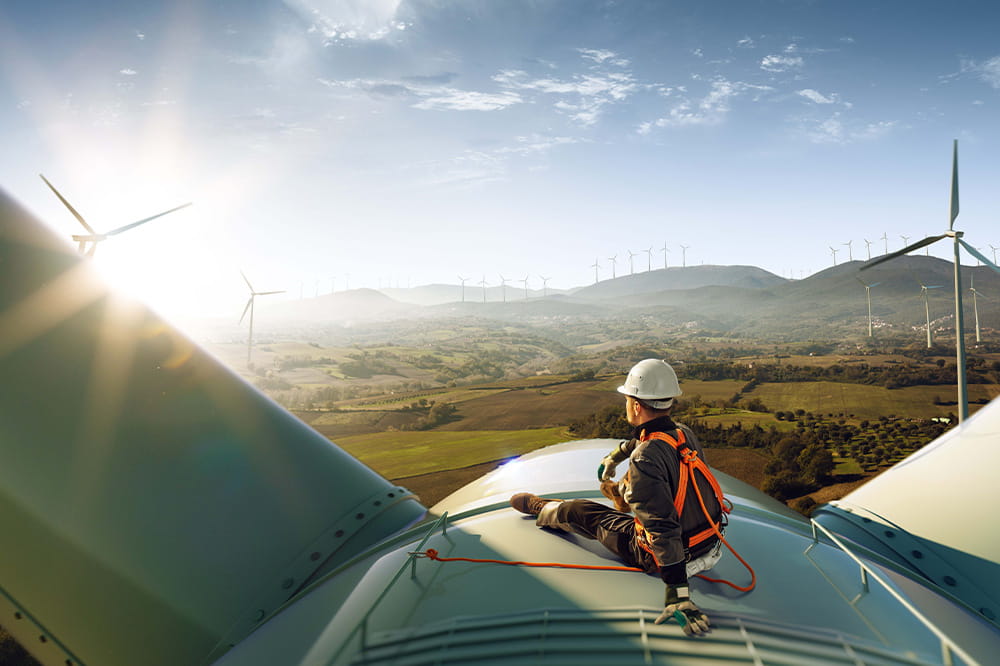
Discover more in our Sustainability Report
In our Sustainability Report, we show how we combine economic success with environmental responsibility – and the concrete steps we are taking to improve our environmental performance. The report was based on the 2025 Global Reporting Initiative (GRI) Standards and the Greenhouse Gas (GHG) Protocol.
Examples of our achievements in sustainability
At Freudenberg Sealing Technologies, sustainability encompasses not only environmental responsibility and social equity, but also economic continuity. These values are embedded within the ESG framework. The following examples show what this means in practice: from innovative packaging solutions and digital resource optimization to employee development and the optimization and security of the supply chain. Each of these examples reflects our commitment to a multi-layered perspective on sustainability as well as to implementing it through concrete projects in different areas of our company.

Packaging and reduction of plastic
A team of employees at our Berlin site has developed a new packaging concept for our DIAvent® product. It replaces the conventional plastic blister packs with casings made from renewable, FSC-certified molded fiber paper that is certified as compostable in industrial composting facilities. This step does not only eliminate plastic waste – it also meets strict cleanliness requirements, reduces CO₂ emissions caused by the packaging compared with the previous plastic blister solution and can be scaled to other sites and products.
Meanwhile, the consistent use of strapping bands instead of stretch film at our Reichelsheim site is paying off. When packaging membranes on pallets, the straps save us around 70% in time and costs and reduce CO₂ emissions by a similar amount. And the machine reduces the physical strain on employees. Now they only need to move the pallet to the machine, which then handles the packaging process autonomously. Exerting physical strength, bending down, kneeling and walking around the pallet – all of that is eliminated.

Employee development
At our Plymouth site in the United States, we redesigned our Academy to promote continuous, self-directed learning. Equipped with modern video tools, podcast studios and flexible training rooms, the Academy supports employees in creating high-quality learning content. A new digital platform provides easy access to tutorials and resources – and underscores our commitment to employee development and a culture of lifelong learning.
At our Plymouth site in the United States, we redesigned our Academy to promote continuous, self-directed learning. Equipped with modern video tools, podcast studios and flexible training rooms, the Academy supports employees in creating high-quality learning content. A new digital platform provides easy access to tutorials and resources – and underscores our commitment to employee development and a culture of lifelong learning.
Digitalization & resources
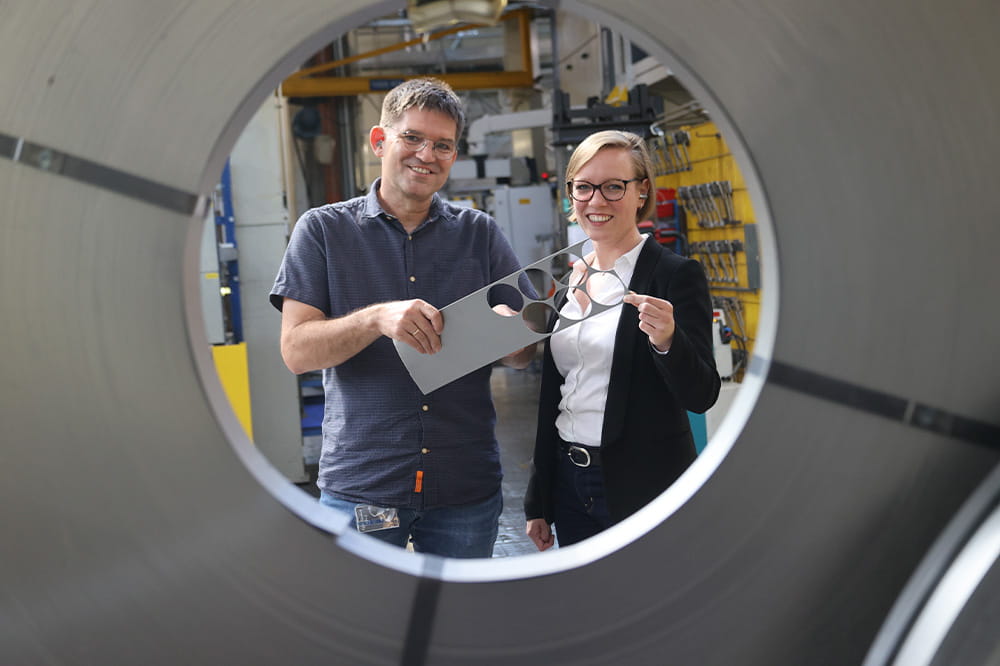
The Weinheim stamping facility has developed a coil width calculator, a tool for determining the width of steel coils. This intelligent planning tool optimizes coil utilization for nearly 5,000 different products. By reducing production waste, the plant saves 240 tons of steel per year and eliminates around 450 tons of CO₂ emissions. The solution also improves inventory management and is now available as a mobile app. This project, which has already been shared with other FST sites as a best practice, demonstrates how digitalization, operational excellence and sustainability go hand in hand.
Electrification and automation enable us to reduce energy consumption in production at an increasing number of sites. In fact, some of the modern manufacturing cells we use consume less electricity than a customary toaster. Investing in electrified machines with lower electricity consumption pays off twice over: It reduces overall fossil-fuel emissions and protects us against future fluctuations in energy prices.
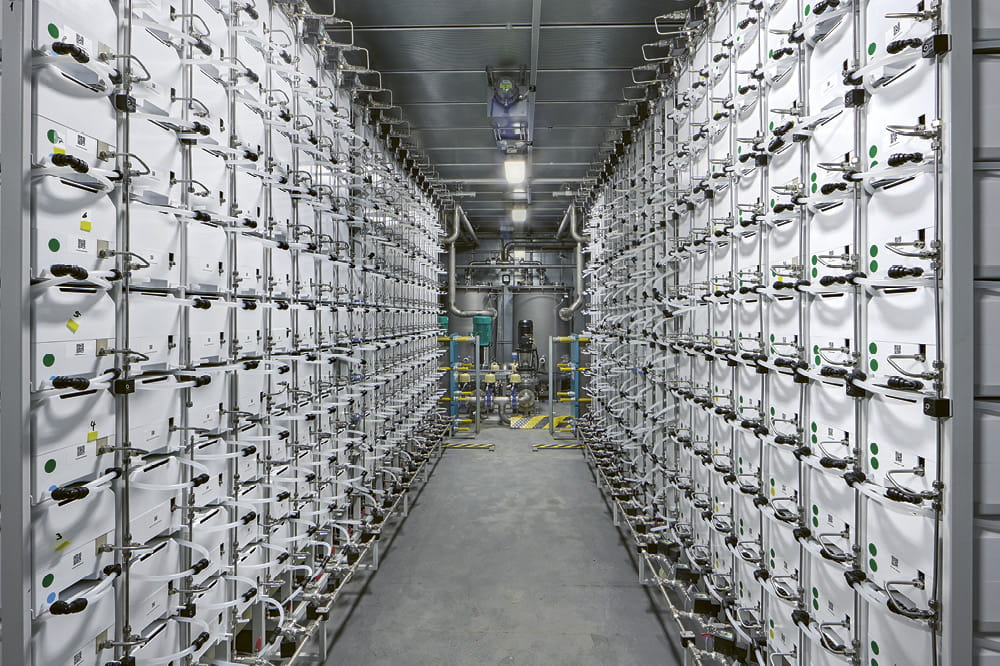
In addition, a high-performance microgrid battery system at our Berlin site helps balance peak loads and buffer fluctuations in electricity from renewable sources. This system helps us reduce energy costs and makes it possible to profitably trade electricity through AI-controlled load management. With this step, we contribute to grid stability – a prerequisite for integrating more electricity from renewable energy sources into the grid.

Supply chain & safety
We continuously encourage our suppliers to reinforce their safety and compliance programs. Our colleagues in India have launched their own supplier initiative, “SaFety First,” which aims to work closely with suppliers to improve safety standards and optimize the working conditions at their facilities. This program emphasizes active participation by the management and strengthens responsibility for ensuring safe working conditions and full compliance with the applicable regulations.
Employees at several sites in Germany and Italy have focused on other effects. They worked out how to optimize the logistics flow between five plants and distribution centers in the two countries. Shipments are systematically consolidated to avoid low utilization rates. A milk-run model coordinates loading and unloading along clearly defined routes. Both of these measures helped reduce transport distances by 75,000 kilometers per year. In addition, two further initiatives are tangibly helping to reduce the associated CO₂ emissions. Intermodal transport was expanded, with road and rail each taking up a roughly equal share. At the same time, using HVO-powered trucks running on hydrotreated vegetable oil made it possible to lower the use of conventional diesel vehicles. The resulting CO₂ savings amount to around 26 tons per year. The new logistics process is proving stable and efficient, reduces costs and serves as a model for the continued development of the global supply chain at Freudenberg Sealing Technologies.
Sustainability in Practice






Freudenberg Group Responsibility Report
Freudenberg Sealing Technologies is the largest of 12 Freudenberg business groups. Its parent company, the Freudenberg Group, joined the UN Global Compact in 2014. The initiative champions sustainable and responsible company management worldwide. Its members are guided by the vision of a sustainable global economy, as enshrined in the United Nations’ 17 Sustainability Development Goals (SDGs). They consistently align their activities with sustainability criteria and develop practical approaches to make their vision a reality and advance the cause of sustainability.
Every year, Freudenberg publishes a so-called responsibility report for the UN Global Compact. It is part of the its annual report and describes its understanding of sustainability. Looking back at the previous year, the report outlines the measures that Freudenberg has used to carry out the Global Compact’s principles and highlights examples of successful sustainability projects.

Join Us!
Experience Freudenberg Sealing Technologies, its products and service offerings in text and videos, network with colleagues and stakeholders, and make valuable business contacts.

 Back to Top