

 Back
Back

Obtain news and background information about sealing technology, get in touch with innovative products – subscribe to the free e-mail newsletter.
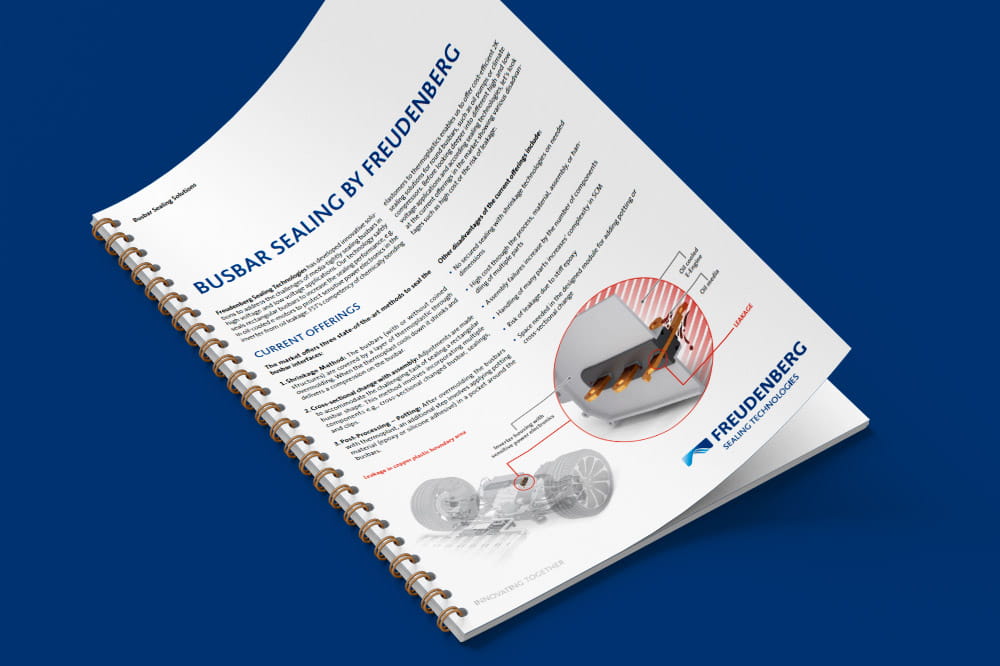

Sealed Busbars for Electrified Power Interfaces
Reliable sealing solutions for busbars, pins and terminals – engineered for demanding electrified systems.
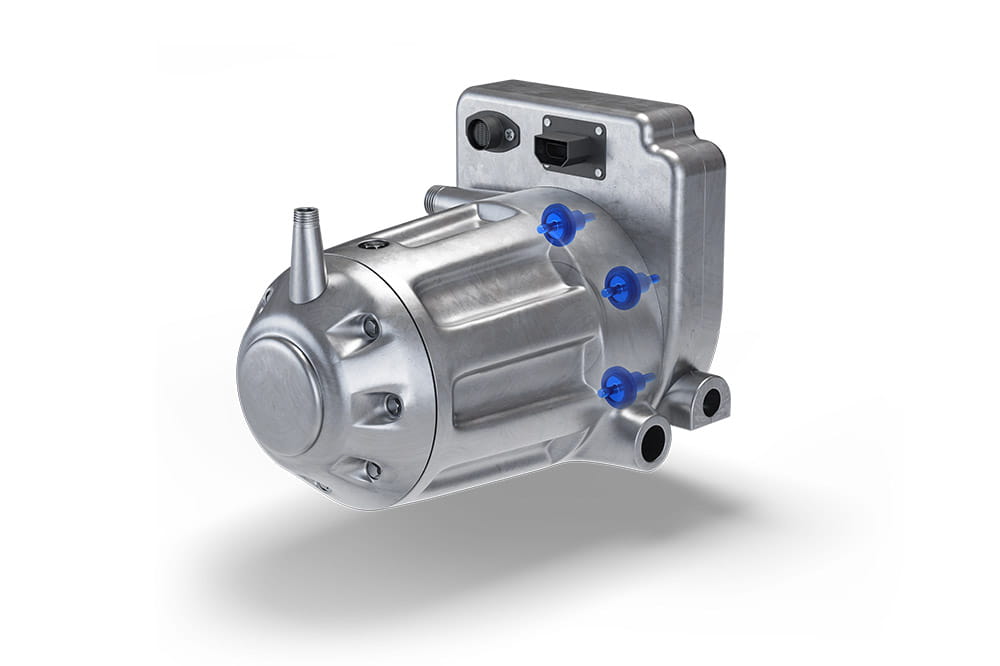
Busbars, pins and terminals are critical electrical interfaces in electrified systems – especially where oil, coolant, gas, pressure or aggressive environments meet sensitive electronics. Freudenberg Sealing Technologies delivers media tight, durable sealing solutions that protect power electronics and enable reliable system performance over the entire service life.
Our sealing concepts overcome one of the key industry challenges:
achieving long term media tightness at metal to plastic interfaces, even with rectangular or complex busbar geometries, thermal expansion, vibration and harsh operating conditions.
Our Solutions & Innovations
- Media tight sealing concepts for round and rectangular busbars
- Integrated sealing elements instead of potting or secondary processes
- Robust designs proven under thermal shock, aging, pressure and vibration
- Design freedom for customers and reduced assembly effort
- Cost efficient solutions through function integration and simplified interfaces
Freudenberg’s approach goes beyond today’s state of the art, enabling sustainable, scalable and production ready sealing concepts for next generation electrified platforms.
Our busbar sealing solutions are designed for a wide range of electrified systems, including:
- Oil cooled electric motors & inverters
- Battery systems & battery management modules (BMS)
- Power electronics and on board power distribution
- Electric pumps, compressors & HVAC systems
- Charging systems and high voltage interfaces
- E axles and electric drivetrains
Looking for a more reliable way to seal critical power interfaces?
Discover how Freudenberg Sealing Technologies helps protect sensitive electronics, reduce system complexity and unlock new design possibilities.
Benefits at a Glance:
-
Media tight rectangular and round bus bar interfaces
-
Total cost advantages for mass production
-
Less assembly effort through function integration
-
Media tightness under challenging operating conditions (e.g., in hybrid transmissions or e-axles)
-
Design freedom of busbar interface and complex geometries possible
-
Sealing for high voltage and low voltage applications
From potting to overmolding: How current-carrying components are made media-tight
How important are innovative sealing solutions for technology trends? Holger Best (Isgatec) talks with Parisa Burger, Business Development Manager at Freudenberg Sealing Technologies, about sealing busbars and busbar pins.
Interested? Listen to our podcast!
Interested? Listen to our podcast!
-
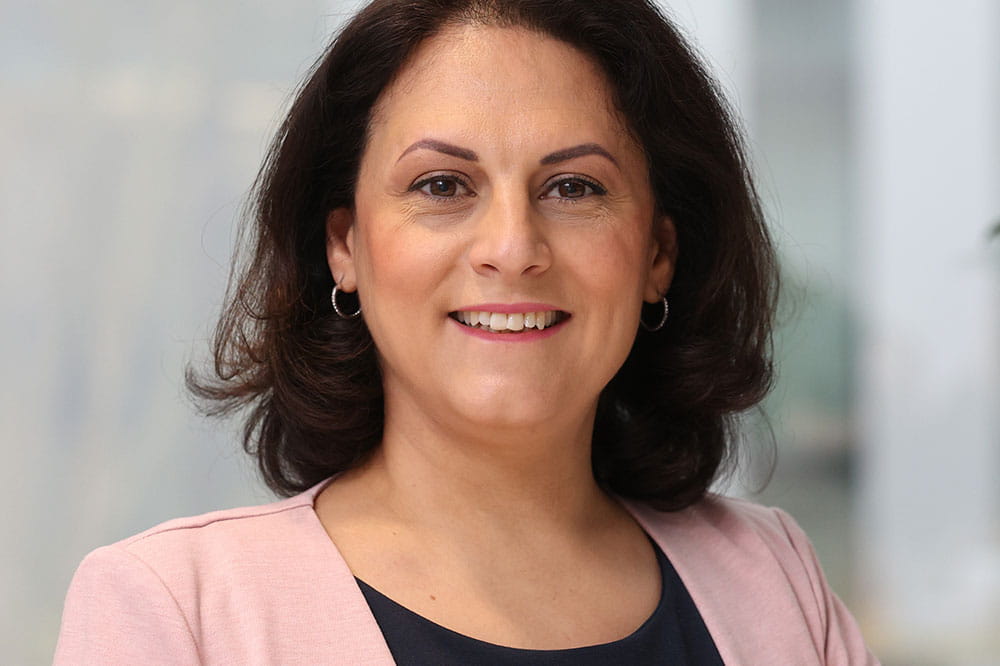 Parisa Burger, Business Development Manager at Freudenberg Sealing Technologies
How important are innovative sealing solutions for technology trends? Welcome to a new episode of our podcast “Alles dicht” (“All Sealed”). Today we want to get to the bottom of this question together with Parisa Burger, Business Development Manager at Freudenberg Sealing Technologies. We’ll use the example of sealing busbars and busbar pins. Glad to have you here today, Parisa!
Parisa Burger: Thank you for the invitation and the opportunity to participate.
Our pleasure. When people think of seals, they often think first of familiar round shapes such as O-rings, flat seals and everything else that comes to mind. But when the parts to be sealed are rectangular or very small and even carry electricity in a wide range of units, you mentally have to take a step out of the familiar sphere of seals. Trends such as electromobility have created new requirements in this area.
Parisa Burger: Yes, we should not be underestimated.
Well, we have already noticed that in various places. Although many discussions about electromobility revolve around charging time, availability of the charging infrastructure and the battery development. Seals don’t really come up, do they?
Parisa Burger: This is understandable, since they are usually invisible and their importance is underestimated. But our e-mobility projects involve seals, which means they are also about answers to the topics you mentioned, such as battery development, sealing of inverter e-motor systems and similar seals. E-mobility wouldn’t work at all without modern sealing technology and that also answers your initial question.
It’s great that we have cleared this up. But let’s move on to a new technical solution that opens up new prospects for e-mobility and other developments in connection with electricity-conducting parts. And that is the sealing of busbars and busbar pins. A quick introduction for our listeners: What are those exactly?
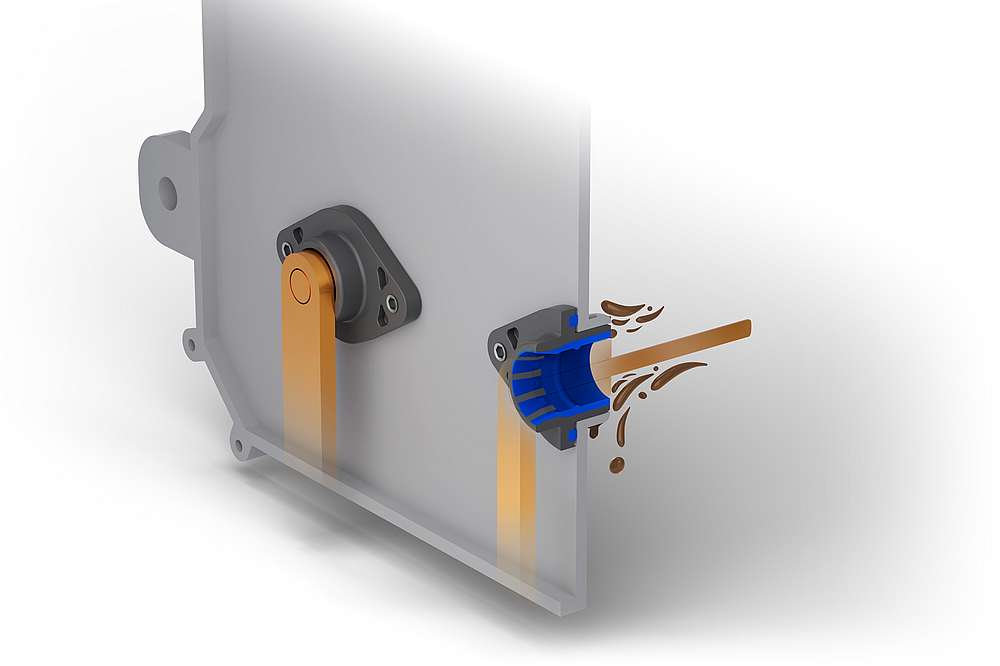
Parisa Burger: Let’s start with busbars. They can also be called conductor rails. I’ll come back to the seals for busbar pins later. Busbars are cables that distribute electricity in a vehicle, like electricity highways. They consist of copper, aluminum or other conductive metals and often have a rectangular cross-section. While this shape takes up little space and is very efficient, it’s a major challenge for sealing. The corners in particular are typical weak points where liquids can penetrate.
Can you give an example to briefly explain why a rectangular shape makes things complicated for sealing?
Parisa Burger: I’d be glad to. Imagine an electric motor. The heart of many electric vehicles. In order for the electric motor to work at all, it has to be connected to the power electronics, the so-called inverters. This is where the busbars come in. They transport the current from the motor’s stator to this inverter. It sounds simple. But it’s actually a real challenge. Most electric motors are oil-cooled. This means that the busbar must be routed through the motor housing and be absolutely leak-tight to ensure that no oil gets into the sensitive power electronics.
I’m familiar with this from other projects, where some of the more complex shapes were sometimes sealed by being cast or bonded. This is often a very time-consuming process and sometimes places enormous restrictions on the vehicle design. Now you have a new technology: the overmolding of electricity-carrying parts to achieve media tightness. How should I picture this?
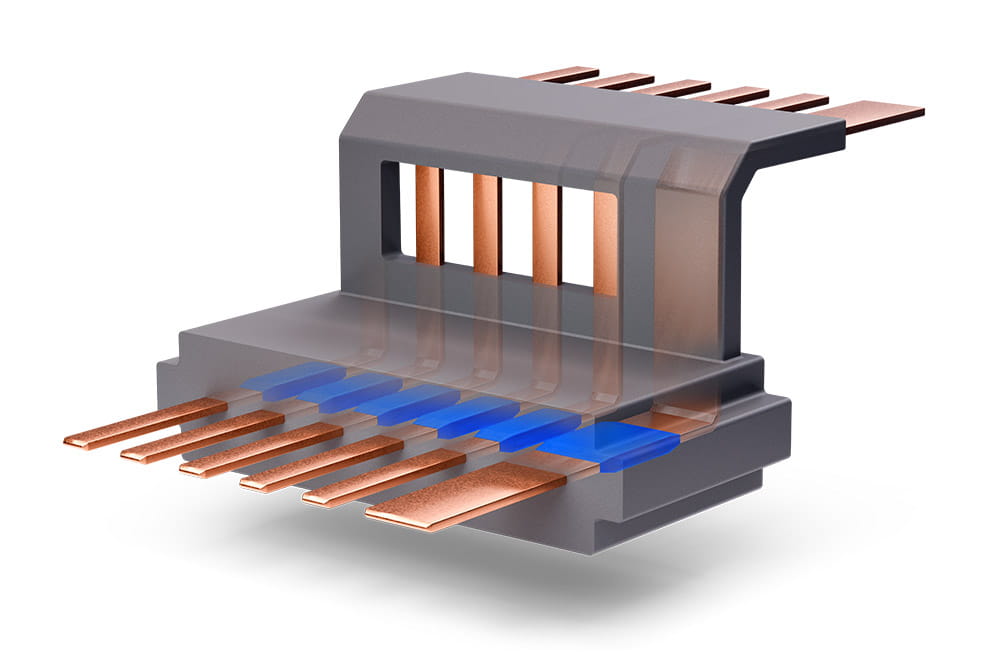
Parisa Burger: As you said, so far there is so-called potting, which means that the sealing is done with epoxy resins or silicone, which of course needs some space. In our process with the rectangular busbars, these are overmolded with a special elastomer layer or sealing geometry. This creates a chemical bond between these elastomer and metal parts, which in turn provides a seamless, media-tight bond. You can picture it like this: The conductor and seal are no longer two parts as before – this chemical bond turns them into a single part.
Okay, and how does this offer advantages for car manufacturers?
Parisa Burger: They save space in the vehicles and reduce time and costs during production. At the same time, this technology increases the reliability of the vehicles. As I mentioned, this is a way to eliminate the previous weak point in sealing these parts.
You just spoke of an elastomer layer as a bonding element. Which materials do you use here?
Parisa Burger: They are advanced materials such as FKM, EPDM, HMBA or AEM from our broad portfolio of materials. These materials have special properties. They are both flexible and very stable with media such as oil or coolants, as well as resistant to high or very low temperatures and even mechanical stresses. And through skillful combinations of these materials, we can create sealing solutions that can meet the most diverse requirements.
You just mentioned advanced materials. The EU is currently discussing whether sealants and adhesives are advanced materials at all. Do you really mean advanced materials here?
Parisa Burger: If these materials and the media-tight composite they are used for are not advanced, then I don’t know what is meant by that.
Okay, so being advanced in the sense of making progress in mobility depends greatly on such materials and the solutions that are based on them.
Parisa Burger: Absolutely. Without advanced materials, many technological trends, from the electromobility we talked about to digitalization and energy supply, would not be possible.
Is this media-tight overmolding only suitable for electricity highways?
Parisa Burger: No, our busbar sealing is also appropriate for low-voltage applications such as busbar pins. These are small busbars conductor rails in a very, very small form, which we already mentioned earlier.
Okay, so these are parts that require sealing on a miniature scale.
Parisa Burger: Yes, here the special focus is on multipin connectors and other small plug connections where numerous pins are housed in tight spaces.
What are the challenges with these components, purely from a sealing-technology perspective?
Parisa Burger: The specifications for sealing these miniature components include tightness, protection classes such as IP protection, material compatibilities and thermal stress. By applying elastomer seals, we can reliably seal even the smallest geometries. We can also integrate multiple functions in one component if needed.
What do you mean by the integration of multiple functions or sealing functions?
Parisa Burger: With precise material selection and intelligent seal design, we can implement features such as tolerance compensation, easier assembly or the specific optimization of the entire module.
Would other functions also be conceivable?
Parisa Burger: In most cases, we develop the busbar installation spaces for the customers ourselves, in-house at Freudenberg Sealing Technologies. This has a major advantage. We make sure that the seals and the installation space are perfectly coordinated. We get functional integration by including additional functions such as centering or fastenings directly in the design. It saves time later on, reduces complexity and creates a solution that is not only tight but also easy to install.
In other words, the technology ultimately provides an innovation toolbox for many areas.
Parisa Burger: You could say that.
And then this can be used to solve tasks in various other sectors?
Parisa Burger: Yes, as long as these are electricity-conducting components, or bus bars in various sizes, which can or must be sealed against different liquid or gaseous media in different environments, which also entails different operating conditions.
Okay, let’s return to electromobility. What prospects does this technology open up for the future?
Parisa Burger: For one, of course, this makes vehicles more reliable, which is crucial for the users. No one wants a car with electrical and electronic systems that fail after a short time. At the same time, it enables manufacturers to make their designs more flexible and production processes more efficient. These technology options are important today so trends can be shaped efficiently and quickly.
A lot is being written about e-mobility in particular to the effect that car manufacturers sometimes lag behind new developments. There are supposedly different reasons for this. Sealing innovations are often viewed with a certain restraint. On the other hand, in the auto industry in particular, products must undergo extensive tests and approvals before something new can be used. In this context, what kind of feedback is the new technology getting from the automotive industry and other sectors?
Parisa Burger: We have the same challenges as everyone else in e-mobility. We don’t have many years of series experience, which is completely normal for a young technology. This is exactly why we are extremely thorough in our validation process. Our products are tested extensively to ensure absolute reliability even without decades of field experience. The results are excellent and our customers confirm this. The positive feedback from our customers shows that we are on the right track together. But we have to provide quick solutions. In many areas, we have also decided to offer prototypes that meet the requirements. At the same time, customers have the opportunity to test these prototypes quickly and give us feedback so that we can initiate the next steps. This allows us to offer solutions that are not only innovative but also robust, fast and ready for series production.
I’m sure this process also creates a certain amount of trust in the new technology, because many companies are entering new territory in this area. I’m also interested in another question: Earlier you said that you have just returned from China. Are there country-specific differences in the acceptance of sealing technologies?
Parisa Burger: Not as far as I have noticed – what is important is that the parts are leak-tight. In China I also noticed that sealing processes both through potting and with O-rings are very well known. But the Chinese market is also very interested in the rectangular busbars, as it enables space-saving work. And our solution is highly regarded there. Thanks to our cooperation with our Chinese colleagues, we have successfully established our solution in the Chinese market as well.
Great. Let’s finish with a more personal question. How does a team come up with such an approach in the first place?
Parisa Burger: Very early on, we at Freudenberg asked ourselves how we could play an active role in shaping the transformation to electromobility. Our key strengths in materials and process development were the starting point. We realized relatively quickly that we could deliver significant added value in the busbar sector. Why? Because we have been able to vulcanize elastomers onto metallic substrate materials for decades. This expertise and our substantial elastomer portfolio were the perfect place to start.
It’s a relatively new approach – ultimately we’re now moving from an earlier mechanical connection between material and seal to a chemical compound on three levels.
Parisa Burger: Yes, right.
What about this technology do you personally find exciting?
Parisa Burger: For me, it’s very exciting to see that we are able to chemically bond elastomers with metal. And with this chemical compound, we ensure that despite temperature fluctuations below or above freezing, the chemical bond remains intact and no cracks form, so that everything remains permanently sealed.
Okay, thank you very much, Parisa, for these insights into a new sealing technology that ultimately helps shape trends, as you described.

The Bundled Expertise
of everything you need to know about busbars

 Back to Top