

 Back

Which materials are suitable for the dynamic loads encountered by seals and dampers in cobots and humanoid robots?
These areas of robotics focus on a perfect coordination of energy and thermal management, optimally generated torques and the ideal power transmission for rotating and linear joint functions and end effectors at the end of the robot arm (EOA – End of Arm). In other words, on mechanical interfaces. In a wide range of environmental conditions, damping elements and sealing solutions are essential components of all body joints, wrist joints and battery units with integrated electronics. For cobots and humanoid robots that work closely with people, excessive friction in even a single joint can delay the activation of safety shutdown mechanisms. To prevent this, Freudenberg Sealing Technologies combines specially developed sealing geometries and damping designs with application-specific materials that ensure consistently low friction over long time periods.
Here are examples of different applications:
Battery modules – Thermal management and operational safety
Battery modules combine battery cells connected in series or parallel to provide the available energy capacity of the robotic system. They integrate a wide range of electronic components. Electrical connections link the battery cells to each other within a module inside protective housing. Ideally designed battery modules with precisely matched sealing solutions reduce the risk of thermal runaway and enable optimum heat and energy management for the sensitive humanoid electronics. At the same time, seals must prevent the ingress of moisture and dust while minimizing damage caused by vibrations and shocks. This requires the following sealing components:
Rotary drive units – Power transmission via joint function
Swivel and rotary drives generate maximum torque within extremely limited installation space and release it across a wide range of swivel angles in swivel and rotary actions. Angles are usually specified within the range of 45° to 360° in robotics applications. These drives are compact assemblies that move a drive shaft through hydraulic or pneumatic pressure. In cobots, rotary drives are required for functions such as tool or workpiece changes. In humanoid robots, they primarily enable turning and holding functions. Reliable motion control and stabilization require the following sealing and damping solutions:
Linear drive units – Motion with highly precise fine adjustment
Linear drives convert electrical energy directly into linear motion and enable robots to accurately perform a wide range of tasks – with precision, efficiency and repeatability. This makes them essential for modern robotics applications. In humanoid robots, linear drives control joints and limbs with humanlike dynamics and natural joint movements. Cobots also benefit from their compact design, especially in confined production environments, and operate safely and reliably in human-machine collaborations – even under challenging environmental conditions. The following sealing and damping components are required in these applications:
Hand assemblies – Sensors and precision
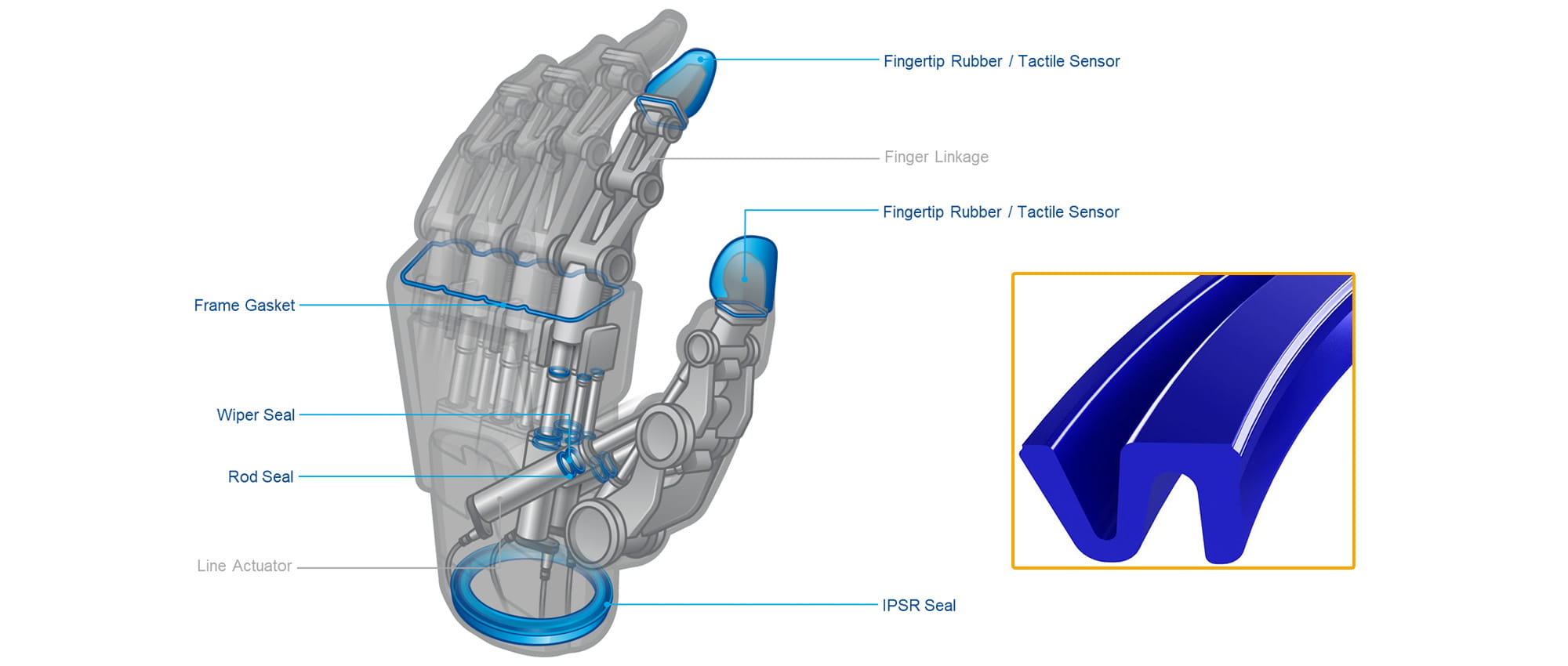
The development and construction of functional hand assemblies represent a core discipline of humanoid robotics. Robot hands are interfaces for interactions. They must be able to coordinate complex movements. They must apply different gripping techniques and respond to external stimuli in such a way that the applied force precisely matches the task at hand. This requires small motors, sophisticated sensor systems and perfectly trained control algorithms. For this highly complex drive technology, many of the sealing components described in the previous sections are required in small-scale formats. However, one decisive area for materials experts has not yet been addressed: tactile sensing:
Sensitive fingertips – conductive polymers
So-called tactile sensing encompasses touch perception and manipulation by robotic hands and, going forward, is intended to approximate the human sense of touch. Various conductive sensor materials are currently being researched. In June 2025, the University of Cambridge announced the development of an electronic polymer skin designed to provide robots and prosthetic devices with near-human tactile perception. This skin is based on conductive carbon nanotubes, which in turn enable robots to interact safely with their environment. Initial elements of tactile sensing are also being developed and tested within the sealing industry, with conductive polymers forming the basis for these pioneering developments.
Sliding seal – see linear drive units, „Rod seals and sliding seal rings”
Other Topics





First Hand News
Best of all, keep up with the latest developments
with the Freudenberg Sealing Technologies newsletter.
 Back to Top